|
 Communication tip: Communication tip:
8 easy steps how to console someone
|

|
|
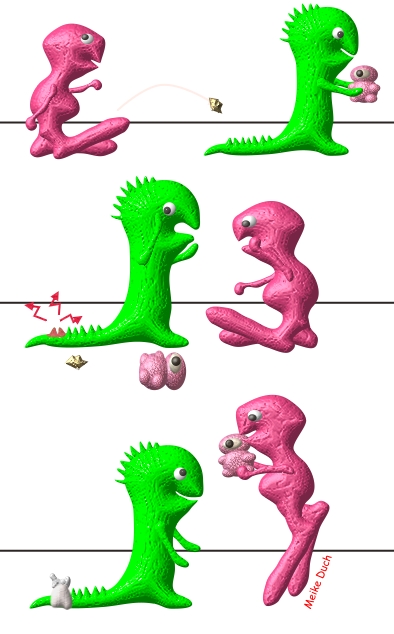
(full picture below)
|
|
It’s always good to know how to console a hurt or shocked or just kind of sad person. Makes live easier – for you and the people around you.
Somehow we find a lot of people on the streets who need first aid, sometimes children, sometimes adults. And they all have something in common: They are much more excited than they want to. And it is easy to console them.
So by thinking, reading, listening, and a lot of learning by doing we found these steps very helpful:
Step 1: Calm yourself down. Step 2: Get his attention. Step 3: Give him the feeling that you care about him. Step 4: Concentrate him on the visual perception. Step 5: Give him the feeling of self control. Step 6: Give him some hope. Step 7: Make him laugh. Step 8: Learn.
Step 1: Calm yourself down
To calm someone down is easier if you calm yourself down first. First advantage: Your voice and behaviour has a comforting effect. And second: You can think clearer. Where do you find a band aid? Where is the favourite cuddly toy? Do you need a cool pack, an ambulance, or just a hearty hug?
You could even pretend to be calm – even if you are not. If you do that convincing enough you will find yourself really relaxed at some point.
Step 2: Get his attention
If a hurt child is screaming it’s lungs out, it can hardly hear what you say. So you have to get its attention before you can do anything else. You can say for example: “Please stop crying so that we can find out what is hurt.” It works! You just have to be convincing enough.
When I was a little kid I tried to learn to ride a bike – and landed after an impressing flight in a beautiful flower bed, bleeding, screaming. And when another little girl came around to tell me that it was “forbidden to sit on flowers”. I immediately stopped crying and crawled out of the green. I was a good child – sometimes. And I still have the scars on my knee.
You just have to be more important or more interesting than the pain or scariness.
Step 3: Give him the feeling that you care about him
Let him know that you are there for him. Tell him that you will help him and stay with him. Hold its hand. Look with a friendly calm expression at him.
Step 4: Concentrate him on the visual perception
Have him look up. If a human person moves his eyes upward, he has less access to its kinaesthetic impressions. Make them move their pupils upward and they
|
|
|
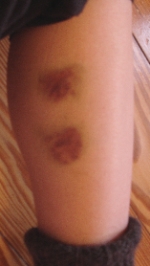
Here is the proof:
I can produce two heart shaped bruises! The originals looked more hearty...
|
|
will have less pain. Neurological trick – very useful! Supportively you can talk about visual things. For example talk about colours and forms of the coming bruise. “Which colour do you want your bruise to get? Blue, green, violet?” Once I had a kid in that situation who said “In the colour of the skin!” I think that’s a very intelligent answer!
(If the child is asking after a few days why the colour is not the wanted one, you can tell him to concentrate on the colour a little more – usually all colours appear in due time.)
“Which is your favourite animal? Do you want a bruise in the form of a guinea pig?” I once could produce two hearts on my calf after a back-stabbing attack of a shelf - and made a picture to prove it.
It would be mean to hug him in a way that he causes him to close his eyes. Draw his attention off. Show him things. You can do it with auditive perceptions as well – but visual is easier and more effective. And be careful with gustatoric (taste) or olfactoric (smell) experiments.
Step 5: Give him the feeling of self control
Give him the feeling that it can decide what happens next. “Do you want to take a seat right here or do you want to sit on the bench over there?” “Do you want to apply a plaster on your knee by yourself or do you want me to help you?” “Do you want to play something different now?”
If possible explain him what others (doctors, nurses...) will do to him before it happens. Scientific examinations say that people notice pain less if they have the feeling to control the situation!
Step 6: Give him some hope
Tell him about his body and how it works for him. Let him know that the scratch will heal. That is good news if you didn’t know that...! And bones are even more solid at a healed fracture.
Step 7: Make him laugh
Humor has an enormous influence on the perception of pain. And it can even speed up the healing!
Step 8: Learn
Talk with him how the accident or illness happened and what both of you can do to be saver in the future. “We have to find a better place to lay away your toys – the closet seems to be safer than the floor.” “Maybe we should try a parachute when we jump out of the plane next time.”
P.S.: Yes, these steps work for adult “children” as well!
P.P.S.: And yes, it is useful to be able to do at least the basics of first aid!
|